
Millwork Drafting Services Built to AWI Edition 3 Standards
Reviewed by our engineering team · Updated August 2026
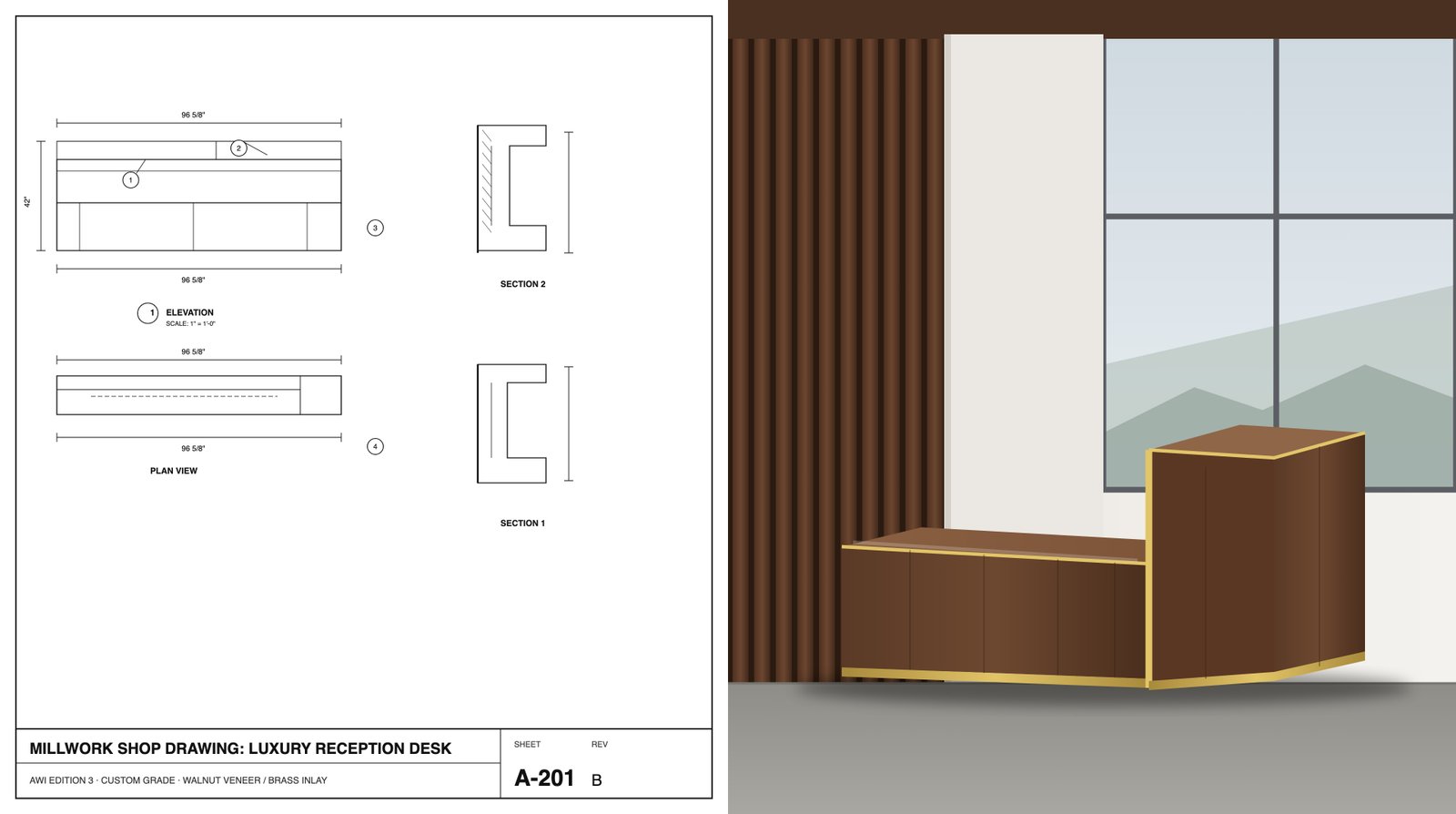
What You Get
Elevations & Floor Plans
Full elevation and plan sheets for every casework and architectural woodwork run in the scope, sheet-numbered to match your submittal set.
Section & Detail Drawings
Wall, base, and reveal sections cut wherever a reviewer or installer would actually need one — not a token detail bubble.
Material & Finish Call-outs
Substrate, veneer, laminate, and finish schedule call-outs tied back to your spec section, not a generic material key.
Continuous Dimension Strings
Dimensions run from a single reference point per elevation, with tolerance bands annotated on the sheet — not stacked part-to-part.
Hardware & Joinery Schedules
Hinge, slide, and joinery call-outs specific enough that your production team isn't guessing at intent.
Revision-Ready File Sets
Native, layered files with a clear revision path, so a change order means an update — not a redraw.
Drafted Against the AWI Architectural Woodwork Standards, Edition 3 — Every Set.
- General notes sheet states AWI grade (Premium or Custom), edition, and finish standard up front — the page reviewers check first
- Dimension strings run continuously from a single reference point per elevation, so tolerances don't stack part to part
- Gap and reveal tolerances annotated directly on the sheet, matched to AWI Ed.3 defaults unless your spec states otherwise
- Joinery, hardware, and finish call-outs specific enough that production doesn't have to interpret intent
- Final sign-off by a senior engineer before any set ships to you
Problems We Solve — That Everyone Else Runs Into
These are the failure points we hear about most from shops, GCs and architects before they switch to us.
Submittals Bounce Back Before Anyone Reviews the Drawings
A missing general-notes sheet — no stated AWI grade, edition, or finish legend — is the single most common reason a reviewer sends a set back unread. We build it in as page one, every time.
Stacked Tolerances Come Up Short at the Shop
Dimensions chained part-to-part instead of from a single reference point are how a cabinet run arrives 3/16" short. Our strings run continuous, so the number on the sheet is the number the installer checks against.
Ambiguous Joinery Call-outs Trigger Mid-Production RFIs
Vague or missing joinery and hardware detail forces a shop to stop and ask. We call out the specific system — not "per standard practice" — so production doesn't wait on an answer.
Redline Cycles Blow Past Bid Deadlines
Every scope includes two revision cycles and a senior-engineer sign-off before delivery, so the corrections a GC or architect asks for don't turn into a second full drafting pass.
How We Do It Differently
Senior-Engineer Sign-Off
Every set is reviewed against AWI Edition 3 standards by a senior engineer before it reaches you — not a generalist checking a box.
3-Tier QA: Drafter → Senior Engineer → Sign-Off
The same internal review chain we've run since 2012, on every project regardless of size.
Career Millwork Drafters, Not a Generalist CAD Pool
We don't draft signage, structural steel, or general architecture. Every project through our shop is architectural millwork or commercial casework.
100% US-Based, NDA & Full IP Ownership
Every engagement runs under NDA with full source-file ownership transferred to you — no offshore hand-off, no shared credit on your drawings.
From your architectural plans to a submittal set your GC and architect can approve on the first pass — no redline cycle required.
Scope & Intake
Send your architectural plans, specs, and any shop standards or title block you want matched. We confirm AWI grade, software, and tolerance requirements before drafting starts.
Drafting to AWI Standards
Elevations, plans, and section details are drafted with continuous dimension strings, material call-outs, and joinery detail your shop or GC can act on directly.
Internal AWI Compliance Review
Every set is checked against AWI Edition 3 general notes, tolerance, and grade requirements by a senior engineer before it goes out.
Delivery & Revisions
You receive a production-ready submittal set with two revision cycles built in, so a reviewer's markup doesn't mean starting over.
Explore Our Other Drafting Services
Frequently Asked Questions
What's the difference between submittal drawings and shop drawings?
Submittal drawings are for architect/designer approval — they confirm design intent, finishes, and dimensions match the spec. Shop drawings go a level deeper, with the joinery, hardware, and construction detail your production team needs to actually build and install the piece. We draft both, and can hand off submittal-approved sets straight into shop-drawing detailing without starting over.
Which AWI grade do you draft to by default?
Premium or Custom grade, matched to what your spec calls for — we confirm the grade during intake rather than assuming. If your project spec is silent on grade, we default to Custom, the AWI baseline for most commercial architectural woodwork.
Can you match our shop's existing title block and CAD standards?
Yes. Send your title block, layer standard, and any drafting conventions your team already uses, and we draft inside them rather than handing you a set that needs reformatting before it's usable.
What happens if a GC's reviewer requests changes after we've already approved a set?
That's what the two included revision cycles cover — send the redline or markup and we turn the correction around against the original scope, without re-drafting the whole set from scratch.
Ready to Start Your Next Millwork Drafting Project?
Send us your project scope and we'll confirm software, timeline, and next steps — whether it's a single set or ongoing drafting support for your team.